Which marketing apps you can build with AI (and which ones are still worth paying for)
With an AI agent you can now build your own contact form, testimonials wall, Meet scheduler or website checker in an afternoon or a weekend. canivibecodeit.com rated 1,093 apps: 158 can be rebuilt in a single session and 420 are not worth it. Which ones yes, which ones no, and how to start.
With an AI agent such as Claude Code, Codex or Cursor you can now build several marketing apps you pay for every month: a form that collects your inquiries, a testimonials wall for your website, a meeting scheduler with Meet, a checker that flags what to fix on your site and a cookie-free visits dashboard. Each one takes a session or a weekend. That is what canivibecodeit.com measures, a directory that rated 1,093 apps: 158 can be rebuilt in a single session, 515 in a weekend and 420 are not worth it. What still cannot be copied is data and infrastructure, like Apollo's contact database.
Think of it as a jacket. For years the only reasonable option was buying it off the rack: standard size, sleeves a little long, and paying every month to wear it. Now there is a workshop that cuts it to measure in an afternoon. Not everything is worth sewing at home, but the habit of piling up subscriptions out of inertia, without asking how much of each one you use, no longer makes sense.
What is canivibecodeit.com?
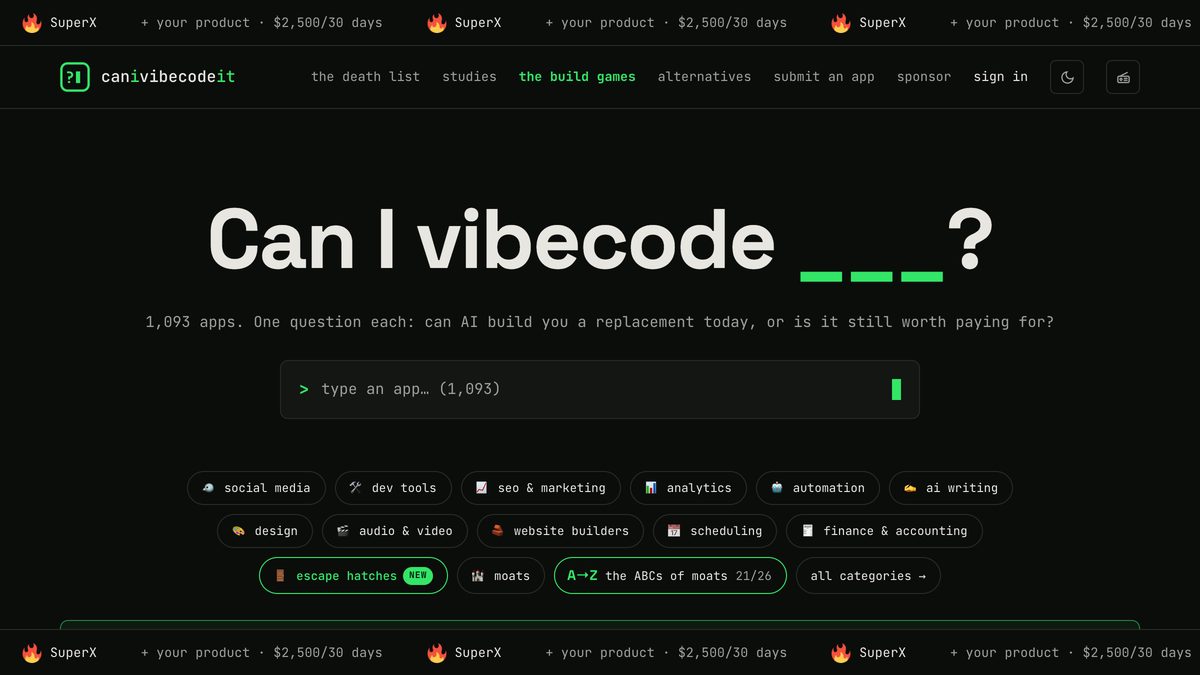
Can I Vibecode It? is a free directory that answers one question for each paid app: can AI build you a replacement today, or is it still worth paying for? To "vibecode" is to program by describing what you want in plain language and letting an AI agent write the code. Each app gets one of three verdicts: YES (one session with an agent), KINDA (a weekend project) or NOT REALLY (it has a real moat and is not worth it).
Each page shows the price with its verification date, what you lose if you replace it, open source alternatives and the exact prompt to paste into Claude Code, Codex or Cursor. It was built by Rob Hallam, a UK developer (@robj3d3 on GitHub) who also builds SuperX, a growth tool for X that appears as the site's sponsor. The code is open source under the MIT license, and visit stats are public: counting started on July 29, 2026.
- Apps rated, 1,093: One by one, with verdict, price and prompt (canivibecodeit.com/stats, 10/23/2026).
- Rebuilt in one session, 158: YES verdict. Another 515 are KINDA (a weekend) and 420 NOT REALLY.
- Visitors from Argentina, 2,770: In the last 7 days, second country after Brazil (3,176), as of 10/23/2026.
- Prompts copied, 18,952: Replacements started since 07/29/2026, per the site's public counter.
Which marketing apps can you build with AI?
We picked the ones most useful to an owner or sales director at a B2B company. Prices in US dollars per month, verified by the site in August 2026.
- Contact form (instead of Tally Pro, US$29). YES verdict. Your version: custom fields, validation, spam protection, email or webhook alerts and spreadsheet export. Built in a weekend. You lose the polished editor, custom domains and ready-made integrations.
- Testimonials wall (instead of Senja, formerly Testimonial.to, US$29). YES, one sitting. Your version: a form for clients to leave their review, a page to approve it and a wall you embed on your site. The site calls it a guestbook that costs US$300 a year. You lose in-browser video testimonials.
- Meeting scheduler with Meet (instead of Calendly, US$12 per user). KINDA, a weekend. Your version: a public page with the next 14 open days, Google Calendar sync, Meet invite, confirmation email and cancel or reschedule links. The fiddly part is setting up Google access. You lose round-robin between reps and SMS reminders.
- SEO checker for your site (instead of Screaming Frog, US$23.55). YES verdict. Your version crawls your site and flags missing titles and descriptions, broken links, redirect chains and pages Google cannot index, with a spreadsheet and HTML report. You lose years of edge cases and the ability to crawl huge sites.
- Cookie-free visits dashboard (instead of Plausible, US$9). YES, a weekend. Your version: a snippet under 2 KB, visits, pages, referrers and countries, without storing IPs. You lose funnels, goals and email reports.
- Link-in-bio page (instead of Linktree Pro, US$15). YES verdict and one of the most voted on the site, with 104 people saying they replaced it.
- Automations (instead of n8n Cloud, US$27.73). YES, with a catch: n8n is open source, so the replacement is self-hosting it. You save the subscription and take on updates and backups.
Watch out with social networks: Typefully (US$12.50), for scheduling posts on X, is rated YES, but its page notes that X's free API is read-only: posting requires a paid tier that costs more than Typefully. Before replacing an app that posts to a network, check what access to that network costs.
Which marketing apps are still worth paying for?
The ones that sell something that is not on the screen. Apollo (US$59 per user) is NOT REALLY: per its page, its value lies in its own contact database, data enrichment, intent signals and sending reputation, things one person cannot rebuild. The same goes for Lemlist, Instantly, Smartlead and Reply.io in prospecting; Semrush and Ahrefs in SEO, because of their keyword and backlink databases; and Salesforce, HighLevel and Zoho in CRM. What you can build is the shell: an email sequence over your own list. The data and inbox delivery are still the product.
It is the same idea we covered in our note on reverse engineering: what you can see of a piece of software can now be described and rebuilt; what you cannot see from the outside (data, integrations, service) is what people keep paying for.
Reverse engineering apps with AI
How to build your first marketing app with AI, step by step
- 1. List what you pay for every month and mark the apps where you only use one feature.
- 2. Look each one up on canivibecodeit.com and read the verdict and, above all, the section on what you lose.
- 3. Start with a low-risk YES app, like the form or the testimonials wall.
- 4. Copy the prompt from its page and run it in Claude Code, Codex or Cursor, in an empty folder.
- 5. Test it with sample data before putting it on your site and decide where it will live (your server or your hosting).
- 6. Write down who maintains it: your own app does not update itself.
It happened to us. In September we dropped Calendly and built our own scheduler: the mambo.ar meetings page connects to Google Calendar and sends the invite with Meet. The code was the easy part; what we had to decide ourselves were the time slots and the rules, and no agent writes that.
MAMBO's scheduler
What the verdict does not tell you: Your own app saves the subscription, but you become responsible for its security, its backups and the client data it stores. If it collects emails or phone numbers, protect them as you would your CRM.
If you want to build your first custom tool with good judgment, or connect the one you have to your CRM and WhatsApp, we can do it with you.
AI implementation at MAMBO
Web development at MAMBO
Getting started with Claude Code
AI implementation in companies: 2026 guide
Claude Code and Codex: avoiding repeated mistakes
Frequently asked questions
What does it mean to vibecode an app?
It is building software by describing what you want in plain language and letting an AI agent (Claude Code, Codex, Cursor) write and test the code. You decide what it has to do and review the result.
Do I need to know how to code to use the canivibecodeit.com prompts?
Not to get started, but it helps. The prompts ask you to install dependencies, set variables and deploy the app to a server. For a form or a testimonials wall, following the steps is enough; for a scheduler connected to Google, it is better to have someone technical nearby.
How much do I save by replacing my marketing apps?
With the first five (Tally, Senja, Calendly, Screaming Frog and Plausible), about US$102 a month at the site's prices, over US$1,200 a year. Subtract hosting and maintenance hours.
Can I replace Apollo or Lemlist with AI?
It is not worth it. You can build the sending of a sequence over your own list, but not the contact database, enrichment or sending reputation, which is what you pay for.
Is canivibecodeit.com reliable?
It is a useful starting point: it shows prices with verification dates, what you lose and alternatives, and its code is open. Verdicts are drafted by a bot from community submissions and the site has sponsors, so use it as a starting point and test for yourself.
Which of your subscriptions is an off-the-rack jacket you could cut to measure this week? Try one, and if you want us to build it together, write to [email protected].
Sources and scope
Data checked on October 23, 2026. The site's figures change daily; prices are the ones the site verified between 07/31 and 08/14/2026 and should be confirmed before deciding.
Can I Vibecode It? (home and Death List)
Can I Vibecode It? public stats (10/23/2026)
Tally page
Senja / Testimonial.to page
Calendly page
Screaming Frog SEO Spider page
Plausible page
n8n Cloud page
Typefully page
Apollo page
Rob Hallam on GitHub (@robj3d3)
Luca Di Domenico: Can I Vibecode It, 950+ SaaS apps (08/04/2026)